Cherry Hill Elite Skylights publishes independent planning guides for Cherry Hill, New Jersey homeowners who notice moisture near a skylight and are not sure whether it is condensation or a real leak. The two problems can leave a very similar wet mark on the ceiling or window frame, but they call for different fixes: one is often a ventilation or humidity adjustment, the other can mean reflashing the roof opening or replacing the glass unit. Getting the distinction wrong wastes money on the wrong repair and can let an actual leak keep damaging the roof deck and framing underneath. This article is educational information, not a remote diagnosis; a qualified provider should inspect the specific roof, skylight, and room before any work is approved.
Start with where the water actually appears
Condensation forms on a surface that is colder than the surrounding air, so it almost always appears directly on the room-side glass or on the metal frame around it, especially on cold mornings after a humid night. A real leak usually shows up as a stain on the drywall or trim around the opening, sometimes at a distance from the glass itself, because water can travel along framing or roof layers before it becomes visible. If the wet area is the glass surface itself, cold weather and indoor humidity are the first things to check. If the wet area is drywall, trim, or insulation near the opening, treat it as a possible leak until proven otherwise.
Fog or a persistent haze trapped between two panes of glass is a third pattern, distinct from either surface condensation or a leak. That haze means the seal inside an insulated-glass unit has failed and humid air has worked its way between the panes. It will not clear with ventilation and it will not respond to exterior sealant, because the moisture is sealed inside the glass assembly itself.
Condensation tends to follow a predictable schedule
Surface condensation on a skylight’s interior glass typically follows the household’s humidity and the outdoor temperature swing. It shows up on cold nights or early mornings, especially in winter, and tends to clear once the room warms or the air moves. Showers, cooking, aquariums, and even a recently finished basement can raise indoor humidity enough to cause this pattern on an otherwise sound skylight. A shaft with little or no insulation, or a unit with an older single-pane or poorly performing glazing package, will show the pattern more often than a well-insulated, modern double-glazed unit.
Because this pattern is tied to humidity and temperature rather than weather events, it usually appears regardless of whether it is raining outside. That is one of the more reliable tells: condensation does not need rain to show up, while a flashing or roof leak almost always correlates with rain, wind-driven rain, or snow melt.
A real leak usually correlates with weather, not just temperature
Water that enters through failed flashing, a cracked curb, or a compromised roof field typically appears during or shortly after rain, especially wind-driven rain that can push water sideways under flashing laps that would otherwise shed a straight-down rain. Snow and ice are a separate pattern: water from melting snow sitting against a curb, or ice damming above the opening, can produce a leak on a day with no active rain at all. Keeping a simple log of the date, the weather, and wind direction when a stain appears or grows is one of the most useful things a homeowner can hand to a provider, because it narrows the likely entry path before anyone opens the roof.
A practical checkpoint before calling anyone
Before describing the problem to a provider, write down whether the moisture sits on the glass itself or on the surrounding ceiling and trim, whether it shows up with or without rain, and whether it has appeared more than once. That short record turns a vague complaint into a specific, testable starting point and helps the provider decide what to inspect first.
What failed flashing actually looks like
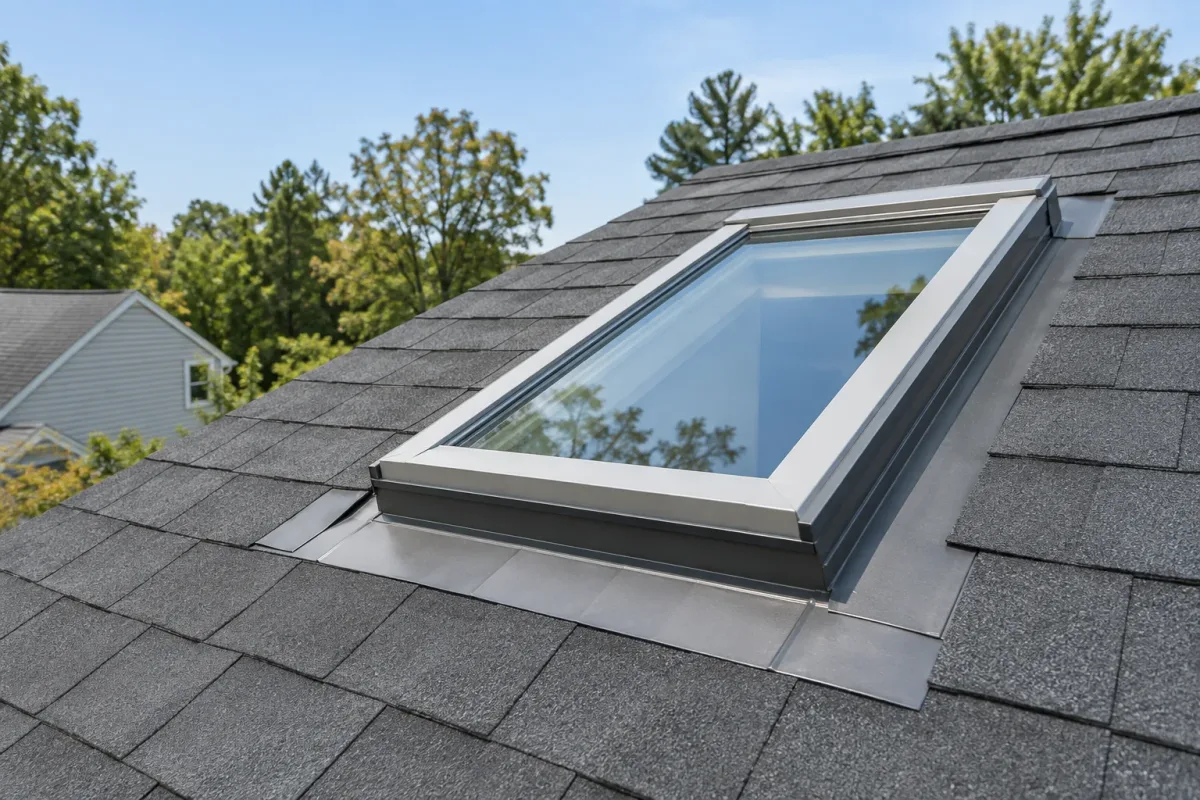
Skylight flashing is a layered system, not a single piece of metal. Properly installed flashing includes a sill piece at the bottom, step or side pieces along the sides that overlap the roof covering in sequence, and a head piece at the top that directs water around the upper edge of the curb. Failure can show up as corroded or loose fasteners, a gap where a side piece has pulled away from the roof covering, a sill that no longer drains cleanly, or an incompatible sealant applied over a joint that should rely on overlap and drainage instead of adhesive. A surface bead of caulk smeared across a visible seam is often a sign that a past repair tried to patch a drainage problem rather than correct it, and it can make the real failure harder to find later.
A roof field problem near the skylight, such as missing or lifted shingles, debris trapped against the uphill side of the curb, or a membrane that has pulled away from the curb on a flat or low-slope section, can also produce a leak that looks like it originates at the skylight itself. Distinguishing a flashing failure from a roof-field failure usually requires controlled removal of some roofing material rather than a visual check from a ladder.
When glass replacement solves the problem, and when it does not
If the fog pattern is trapped between sealed panes and the frame and flashing are otherwise sound, replacing the glass unit alone can resolve the issue without disturbing the roof opening. That option depends on whether a compatible replacement glass unit is available for the installed frame and whether the frame itself is in good enough condition to support it. If the frame has deteriorated, if the unit is old enough that matching glass is no longer available, or if a leak investigation finds damage beyond the glass, a full skylight replacement may be the more durable answer even though the original symptom looked like a simple glazing problem.
Choosing between reflashing and full replacement
Once a leak is confirmed to originate in the flashing rather than the glass or a roof-field defect somewhere else, the next decision is whether a targeted flashing repair can correct it or whether the scope should expand. A bounded flashing correction can work when the skylight unit, curb, and deck are sound and the problem is isolated to the flashing pieces themselves. A broader leaking skylight repair investigation, or a step up to full skylight repair or replacement, becomes the better path when the deck underneath has deteriorated, when the curb has shifted, or when the roof covering around the opening is old enough that disturbing it for a flashing repair would not leave a durable result. A written scope should say which layer is being corrected and which related conditions, if any, are being left outside that scope.
Build a Cherry Hill-specific record before calling
Whichever pattern matches, a useful first message to a provider should include the address, the room and roof type, the approximate age of both the roof and the skylight, a description of the moisture pattern and when it appears, and photographs of the stain or fogging taken from safe, ordinary locations. Note any planned reroofing, since timing a flashing correction around a reroof can avoid redundant work on the same area. Do not climb onto the roof, remove interior trim, or disturb wet electrical controls to gather more information.
For a property-specific assessment in Cherry Hill, New Jersey, send the room, roof, and symptom details or use the number shown on this page. The request will be reviewed and may be routed to a local provider who can inspect the property directly. For a broader comparison of repair and replacement decisions beyond condensation and flashing, see the repair or replace evidence guide.
Sources and planning references
- Cherry Hill permits and Construction Office
- New Jersey Division of Codes and Standards
- ENERGY STAR residential windows, doors, and skylights
- U.S. Department of Energy daylighting overview
Use the guide, then inspect the property.
01Can I tell condensation from a leak just by looking once?
Rarely. A single look at a wet mark does not show whether the water formed on the glass surface or arrived from outside. Timing, weather, and location on the unit matter more than one observation.
02Does fog between the glass panes mean the skylight needs replacing?
Fog or a milky haze trapped between sealed panes usually means the insulated-glass seal has failed. Depending on the product and frame condition, that can be a glass-unit replacement rather than a full skylight replacement.
03Will sealing the edges around my skylight stop the water?
Only if the water is entering through that exact sealed joint. Flashing and roof-field leaks often travel along layers before showing up at the skylight, so sealant applied to the wrong spot can hide the problem without fixing it.
04How long does flashing usually last on a Cherry Hill roof?
Service life varies with material, installation quality, and roof exposure. Rather than relying on an age estimate alone, a visible inspection of the sill, step, and head flashing is the more reliable way to judge remaining life.
05What should I photograph before calling someone about a wet ceiling?
The stain location and size, the date and recent weather, and any visible glass fogging. Do not climb onto the roof or remove interior trim to look further.